

Practice alone does not lead to proficiency—practice with feedback does.
Feedback – a well-known concept with many meanings
Feedback is a well-established concept in both research and practice. But what is meant by feedback often varies depending on who you’re talking to and whether you’re referring to popular science or research published in academic journals. One thing is certain: everyone has some kind of relationship with feedback. We encounter feedback in organisations through performance reviews, one-on-one meetings, annual performance discussions, and in everyday interactions at the coffee machine. In research, feedback recurs in a variety of contexts and is studied from multiple perspectives. In fact, if you look at publication trends in one of the most prestigious journals in behavioural analysis— the Journal of Organisational Behaviour Management (JOBM) —feedback is by far the most frequently used independent variable (Van Stelle et al., 2012). But why is there still such intensive research on feedback? Shouldn’t we have figured out how it works by now, after more than 100 years of research? Well, there are some things we know very well, while others remain less clear.
Why all this research?
Part of the complexity stems from the fact that feedback can function as both a trigger and a consequence—and sometimes both at the same time (Mangiapanello & Hemmes, 2015; Peterson, 1982).
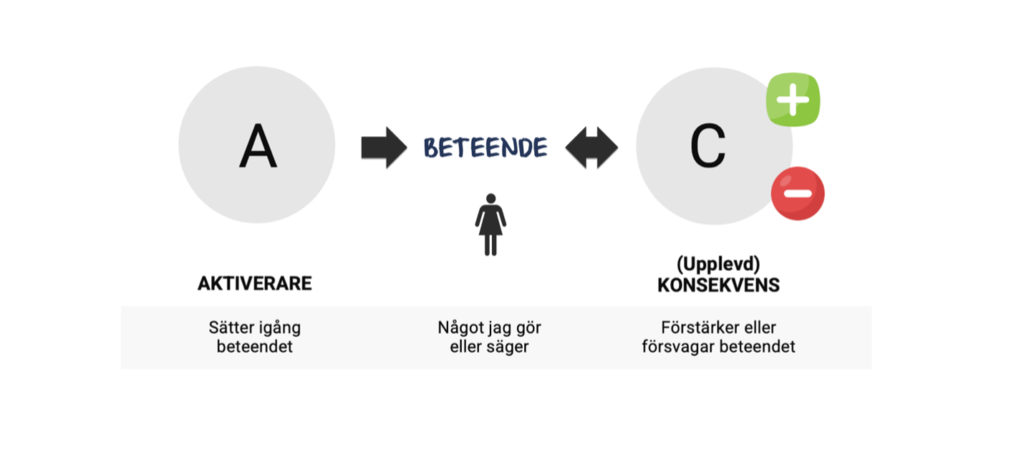
Image: Overview of the ABC model. If you're not familiar with the model, you can read more here.
This may seem confusing—is there no consensus on feedback? And how should we use it effectively? Fortunately, there are a few solid points of reference. One of the clearest is that researchers agree that feedback acts as a stimulus (what is a stimulus?). The fact that feedback is a stimulus means that it can fulfill different functions in the ABC model depending on when it’s given, how it’s formulated, and how the recipient interprets it. It also means that the answer to the questions above is… well, somewhat unsatisfying:
"It depends"
Learning History – Why the Same Feedback Is Perceived Differently
One of the key reasons why feedback works so differently for different people is our learning history (Johnson et al., 2023). Our past experiences shape how we perceive and react to different types of information. This means that the same feedback can be perceived as helpful by one person and critical by another. Some feedback can be motivating, while other feedback can lead to avoidance behaviour. How we interpret feedback determines its effect—not what the sender intended.
A manager can offer exactly the same well-intentioned encouragement to two employees but elicit two different reactions.
Manager: “I saw the presentation you just gave. It was great! Please send me the next version in advance so I can make sure everything is correct.”
Employee A: “It’s great that they saw my work—it’s nice to get help ahead of time.”
Employee B: “They don’t trust me. Here we go again with the micromanagement.”
The same feedback, but two completely different functions. For A, it serves as support; for B, it is a control stimulus that causes stress or avoidance behaviour. Ultimately, this means there is no single way to provide feedback—the subjective experience is what matters.
What does this mean for you as a leader?
For those of you who lead others, this means that effective feedback isn’t about following a template, but about understanding the person in front of you. This means that:
For those of you who lead others, this means that effective feedback isn’t about following a template, but about understanding the person in front of you. This means that:
- Identify what actually motivates the individual (preferably using the ABC model!)
- Adjust the form, timing, and frequency of feedback
- Continuously evaluate how feedback is received, not just how it is given
When feedback is tailored to the recipient’s needs and is perceived as meaningful, it becomes one of the most powerful tools we have for reinforcing behaviours, developing skills, and building sustainable performance.
References
Van Stelle, S. E., Vicars, S. M., Harr, V., Miguel, C. F., Koerber, J. L., Kazbour, R., & Austin, J. (2012). The publication history of the Journal of Organizational Behavior Management: An objective review and analysis: 1998–2009. Journal of Organizational Behavior Management, 32(2), 93–123. https://doi.org/10.1080/01608061.2012.675864
Johnson, D. A., & Johnson, C. M. (2022). Foundations and Advances: Revisiting the Past and Selecting for the Future. Journal of Organizational Behavior Management, Advance online publication, 1–7. https://doi.org/10.1080/01608061.2022.2029797
Mangiapanello, K. A., & Hemmes, N. S. (2015). An analysis of feedback from a behavior analytic perspective. The Behavior Analyst, 38(1), 51–75. https://doi.org/10.1007/s40614-014-0026-x
Peterson, N. (1982). Feedback is not a new principle of behavior. The Behavior Analyst, 5(1), 101–102. https://doi.org/10.1007/BF03393144
Douglas A. Johnson, C. Merle Johnson, and Priyanka Dave (2023) “Performance Feedback in Organizations: Understanding the Functions, Forms, and Important Features,” Journal of Organizational Behavior Management, 43:1, 64–89, DOI:10.1080/01608061.2022.2089436